I should be studying maths right now 🙈. Instead I’m writing this article first, with a cup of green tea next to my laptop, because I want to catch the story while it is still young.
Over the last three weeks, my little team of AI agents has grown from one to five. I have not written down in one place who is on the team, what each one is for, and which model runs underneath. So this is that post. And it is also the first of a series: every few weeks I want to post an update on who joined the crew, who is barely used, what it all costs, and what surprised me.
TL;DR
- What this is: a snapshot of my Hermes crew on 11 October 2026, and the start of a series that documents the journey.
- Who is on the team: Hermes (coordinator), Ada, Ivy, Pi and Clark. Four specialists plus one coordinator.
- What I found out: most of the work is not in the model, it is in the setup around it: a personality file, a memory, some rules and a schedule.
- A correction: not everything on my server is an agent. Some parts are plain scripts, on purpose.
- Planned: Luna (books), Jamie (food), Polly (languages) and Kate (a novel). None of them exists yet.
- The shared vault: my agents work on a common folder of plain text files that I can open in Obsidian too. It is not ideal yet, but it already does a lot of work.
- Not in this post: costs and usage numbers. Those come in the next update, together with the problems I ran into and how this has changed my work.
A note on how this post came about
The technical facts in this post (models, dates, schedules, providers) come from a summary that Hermes wrote for me on 11 October 2026. It read the configuration files, the gateway logs and the session databases of my agents. I treated that summary as the ground truth. Ivy, my writing agent, who helped write this post, runs on
anthropic/claude-sonnet-5.5through the Nous Portal, with reasoning effort “medium”. I checked the text, the facts and the links before publishing.
First, what is an “agent” anyway?
I use three words, and they are not the same thing.
- A bot follows fixed rules. No understanding, no decisions. Example from my server: a small script that syncs my notes every two minutes.
- A chatbot has conversations, usually with a language model, but it only answers with text.
- An agent is a language model plus tools, memory and a loop. It understands a goal, plans steps, uses tools (files, terminal, browser, web), checks the result and keeps going.
The Hermes documentation says it is not a coding copilot tethered to an editor and not a chatbot wrapper around a single API. It calls Hermes Agent an autonomous agent that lives wherever you put it, in my case a small server (the setup is in an earlier post).
The honest part: not every piece of my setup is an agent. My job radar is a script on a schedule. The note sync is one too. Hermes even has a name for this: no-agent mode, a scheduled script without a language model, where whatever the script prints is the message. Clark’s morning routine has recently moved to this form as well (more on that below). The rule I try to follow: use a plain script where fixed rules are enough, and an agent where judgement is needed.
What a Hermes agent is, and what it is not
In Hermes, an agent is a profile. According to the profiles documentation, a profile is a separate home directory with its own configuration, keys, memory, sessions, skills, cron jobs and state. In my setup, that adds up to a few files:
SOUL.md: the personality. Name, tone, task, limits. It comes first in every session. (See Personality & SOUL.md.)config.yaml: which model and provider the agent thinks with, and how much reasoning effort it uses.- Memory: a small, permanent notebook that is loaded into every new session. (See Memory.)
- Skills: reusable how-to documents the agent loads when a task fits.
.env: secrets only, like the bot token and API keys.
Creating one starts with a single command, hermes profile create <name>, as the documentation shows. After that I give it a description and a personality, set the model and connect it to Discord. I test the connection first, then the Discord message, and only then do I add schedules and skills.
What a profile is not: a sandbox. The documentation is explicit here: profiles do not sandbox the agent. On the default setup, the agent has the same file access as the user account it runs under. In my crew, the separation between agents, for example that Ivy never reads Ada’s coaching notes, rests on rules written into the personality files. Those are prompt text, not a technical lock. I find that important to say out loud. It works because I trust the setup, not because it cannot go wrong.
The crew today
All five profiles run inside one gateway process on my server, and each has its own Discord bot. All five are connected right now. I talk to them mainly through direct messages. The Desktop app and the terminal work too.
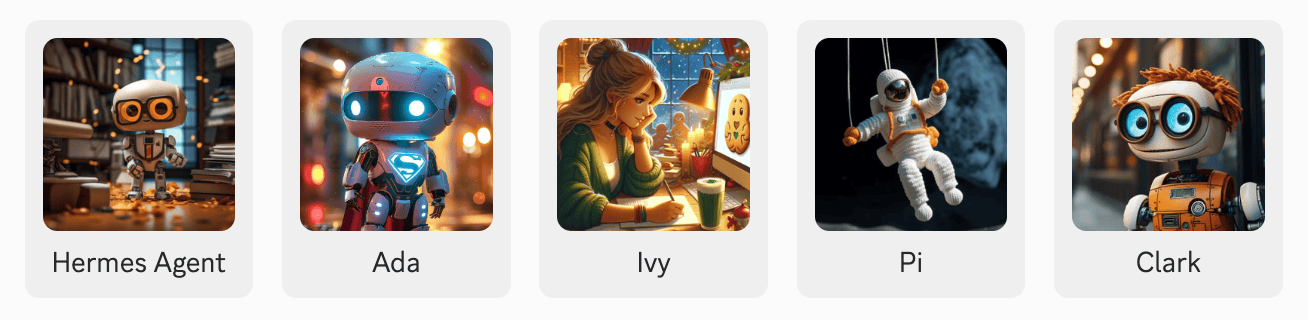
Hermes is the coordinator, and my first point of contact when I am not sure who is responsible. It created the other profiles, configures models and providers, sets up schedules and updates the system. It hands short helper tasks to temporary subagents and long-running ones to a Kanban board (Delegation, Kanban). Hermes is the coordinator, but not a boss in the technical sense: the agents run side by side and do not talk to each other automatically. At the moment handovers happen through me, through shared files, or through a delegation I ask for explicitly.
Ada is my work and learning coach: motivation, procrastination, planning, recovery. She is not a subject tutor. Her personality is warm, intelligent and occasionally funny, a good friend who is kind but direct, and who never shames me. Her coaching conversations stay private, and she does not pass them on to the other agents. She also sends me a morning check-in at 08:00 Berlin time.
Ivy is the one writing this draft: author and editor for this site. She helps with ideas, outlines, drafts and fact checks. Her rules are written in her personality file: write as me, in English, never invent tests or quotes, and mark every gap with a ✏️.
Pi is my maths tutor for the M.Sc., currently a pilot for Unit 1 of Advanced Mathematics. He is patient, works with an example first and the formula second, and gives me one exercise at a time. He records progress only from real answers. By design, Pi has no schedule and never writes to me first.
Clark is my AI news editor. Every day at 05:00 Berlin time he delivers a briefing. He is curious, precise and a bit dry. He puts evidence before claims, and he writes “PARTIAL RESULT” instead of a false “done”. Since 11 October, his schedule runs as a script job (collector, Clark, evidence check, Discord message). The earlier version, where an agent ran the whole thing, is paused.
| Agent | Role | Created | Started on | Runs on today |
|---|---|---|---|---|
| Hermes | Coordinator, technology, operations | 19 Sep 2026 | gpt-6-astra (OpenAI Codex, subscription) | anthropic/claude-sonnet-5.5 via OpenRouter |
| Ada | Work and learning coach | 26 Sep 2026 | claude-sonnet-5 (Anthropic direct) | deepseek/deepseek-v4.1-flash via Nous Portal |
| Ivy | Writer and editor | 27 Sep 2026 | gpt-5.6-terra (inherited), within the hour deepseek/deepseek-v4.1-flash | anthropic/claude-sonnet-5.5 via Nous Portal, reasoning medium |
| Pi | Maths tutor | 4 Oct 2026 | gpt-5.6-terra (inherited) | gpt-6.1-sol (OpenAI Codex, subscription), reasoning medium |
| Clark | News editor | 9 Oct 2026 | anthropic/claude-haiku-5.5 via Nous Portal | unchanged, via his own Nous key, reasoning low |
Two small details I like. First, when I create an agent without choosing a model, it simply inherits the default model. That is how Ivy and Pi started on the same one. Second, I can switch a model with a command or a config change, without rebuilding the agent. Hermes itself has run on several models in between, and Clark had a single test run with deepseek/deepseek-v4-pro-0813.
Why these models?
The honest answer: pragmatic, not scientific. I did not run a formal model evaluation, and I cannot claim the current choices are the best ones. What I can say is what I was thinking:
- Ada started on Claude Sonnet 5 and moved to the cheaper DeepSeek V4.1 Flash.
- Ivy runs on Claude Sonnet 5.5 because I wanted good text.
- Clark uses the small, cheap Haiku 5.5 with low reasoning and a 150-second budget, because his daily job is routine.
- Pi uses an OpenAI model through my subscription instead of API billing.
The providers are a mix: OpenRouter, the Nous Portal, Anthropic directly (for a helper model that compresses Ada’s context), and OpenAI Codex through my subscription. Clark has his own Nous key, so that I can see his costs separately. Whether this mix is the cheapest way is exactly the question I want to answer in the coming weeks. I wrote about the API-key route for Claude in an earlier post.
One place for what the agents know: the vault
My agents share more than a server. They also share a folder of plain text files, an Obsidian vault that lives on the server. I can open it with Obsidian like any other collection of notes, and I can read exactly what the agents read. Obsidian is not new to me: I have been using it for almost three years, mainly for work and my studies. That is a different vault, and I never gave Hermes access to it. I only set up access to the crew vault, the one in this post, and I synced it between my local machine and my Hostinger VPS. On the server, a small script job runs the sync every two minutes, with no language model involved.
The idea behind part of it comes from Andrej Karpathy’s LLM Wiki. He describes the usual way of working with documents and an LLM as search at question time: the model rediscovers the knowledge from scratch on every question, and nothing builds up. His alternative is a wiki that the LLM builds and keeps up to date. I have not copied his setup one to one. I took the shape of it.
In the vault, the Wiki folder works like this:
SCHEMA.md: the house rules, for example that every page needs a short header and links to other pages.index.md: a catalogue of every page, one line each.log.md: a diary of every change.raw/: untouched sources.- Pages for concepts, comparisons and reusable answers.
Ada looks after the wiki. The technical facts in this very post come from one of its pages: a technical background note that Hermes wrote about the crew. I used it as my ground truth.
Beyond the wiki, the vault is simply where the crew keeps its working material:
- Ada uses it to tell me what is on my to-do list. The tasks are sorted into four areas: work (the university), studies, Code & Value (this website) and private. She also moves tasks between lanes, for example from today to soon, next, someday and done. On top of that, she has already set up reminders and cron jobs. That is a story for another post.
- Ivy keeps her reference material there: my published posts (the archive that Ada keeps current), the weekly blogging prompts with their templates, my idea notes, and her own briefing and style guide. That is why she can write in my voice without me pasting everything into every chat.
- Me: I can see, check and correct what the agents work from. Compare that with the small built-in memory I described earlier: files in the vault have no 2,200-character limit. The agent just needs to be told to read them. That is how it works in my setup: a personality file stays short and points to the files an agent should read before a task. (This comes from my own configuration, not from a test.)
I will keep referring to the vault in these updates, because it is a big part of how the crew works.
The catch, again: it is not ideal yet. Every agent has the same file access as the user it runs under, as I said above. The coaching notes with Ada sit in the same vault as everything else, in a folder the other agents are told to leave alone. Told, not locked.
Who is planned: Luna, Jamie, Polly and Kate
Four more agents are on my list. None of them exists yet. Here is what I have in mind, and what I do not know.
Luna: finding books. Luna should help me find my next book. She will run on Gemini Flash. My reason is a plain personal observation: I use Gemini in the chat on the official website, and I often ask it for a recommendation for my next book. It already knows me well enough to know that I like urban fantasy and science fiction. Which Gemini Flash version I will use is not decided yet.
Jamie: food. Jamie, named after the chef Jamie Oliver, should answer spontaneous questions with simple, healthy, vegetarian recipes. Typical question: it is 7 in the morning, I am in the office today, what healthy vegetarian thing can I still prepare quickly and take with me? Same model idea as Luna, same reason: I already ask Gemini exactly this.
Two caveats for both. First, I have not yet tested whether the Gemini models run in Hermes with my access. Hermes does support Google Gemini with an API key (GOOGLE_API_KEY or GEMINI_API_KEY, provider gemini, see Providers). Whether my student subscription gives me such a key, I do not know yet. It is item 5 on my to-want list. Second, what Gemini knows about me lives in the Gemini app. As far as I can tell, a Hermes agent does not get that for free. Every profile has its own memory, and it is small: according to the documentation, MEMORY.md holds 2,200 characters and USER.md 1,375 characters. So I will have to carry a little of my taste over myself, and I want to keep it short on purpose. (That is my reading of the documentation, not a test.)
Polly: learning languages. Polly should help me with shadowing, from English B2 towards C2. Shadowing means you listen to speech and repeat it right away. This one comes with a deliberate “check whether we can do this”: Polly would be the first agent that has to listen and speak. All others work with text. The Hermes docs describe, for the Desktop app, dictation, reading replies aloud and full voice conversations, and the Tool Gateway includes text-to-speech. I have not tried any of it. I do not know if it is good enough for shadowing, or whether it works the way I would use it. The model is still open.
Kate: a novel. Kate should help me write a novel about a strong woman. The direction is still open: urban fantasy in the spirit of Kate Daniels by Ilona Andrews, or space opera. Her special challenge: this agent has to know a whole world, with characters, places, rules and plot lines. Where that story canon lives is not decided. The built-in memory is far too small for it (see the limits above). Candidates from the documentation are skills, context files, or an external memory provider. My own idea is the shared vault: a folder of story notes that Kate reads before she writes. That list is my inference from reading the docs and from how my crew works today. I have tested none of them. The model is open, too.
What I am still unsure about
- Costs: I already keep an eye on them, but so far that is mostly a feeling plus a targeted look whenever I want to know. What I am missing is a proper table. It is coming soon.
- Usage: which agents I use a lot and which barely is something I want to show with real numbers next time.
- Quality: My gut feeling tells me fairly well which model to use for which job. But I have not written much about it, neither on paper nor in a post. I did not run a formal comparison, so “gut feeling” is the honest label. That is something I want to change.
- The vault: it works, but the setup is not ideal yet.
- Ada’s extras: a few planned connections for Ada are not set up yet.
What’s next
The next update will cover three things: a cost table for the crew, which problems I ran into, and what surprised me. I also want to write about how all of this has changed my daily work, and I would like to describe that when I have lived with it a bit longer. In between, I will keep going with my to-want list: testing models for each agent, comparing costs, and watching what the agents actually do in the background.
If you run a small crew of your own, I would love to hear what yours looks like.
Sources
- Hermes Agent Documentation: what Hermes is and what it is not
- Profiles: Running Multiple Agents, including Profiles vs workspaces vs sandboxing
- Script-Only Cron Jobs (No LLM)
- Personality & SOUL.md
- Memory and Memory Providers
- Skills System and Context Files
- Delegation and Kanban Multi-Agent
- Providers (Google Gemini via API key)
- Hermes Desktop and Nous Tool Gateway (voice and text-to-speech)
- Andrej Karpathy: LLM Wiki (GitHub Gist) and Obsidian
- Earlier posts: Hermes on a Hostinger VPS, My First AI Agent – That Isn’t Really an AI Agent, Adding Claude to Hermes on My VPS, My To-Want List for Q4 2026