Sunday, 14 June. Perfect weather for procrastinating on the maths module by working on a side project instead. Don’t worry, I see it too. But this side project happens to be directly useful for my actual job, so I’m calling it a productive Sunday and moving on.
Here’s what happened on 9 June, and what happened to it since.
The Setup: A New Model With a Looser Leash, For Now
On 9 June, Anthropic released Claude Fable 5, the first publicly available model in their “Mythos” class. A bit of context, because the naming is genuinely confusing: Mythos isn’t a separate product, it’s a capability tier. Anthropic had been testing Mythos-class models since spring with a small number of vetted partners, mostly because these models turned out to be exceptionally good at finding security vulnerabilities in code, useful for defenders, obviously also useful for attackers. Fable 5 is the version of that same underlying model made available to the rest of us, wrapped in safeguards that are supposed to dampen exactly that vulnerability-hunting capability in risky contexts like cybersecurity and biology. Mythos 5, the unrestricted sibling, stayed limited to the vetted partner group.
So: same base model, different leash length.
The other detail that mattered to me: Fable 5 was included in Pro/Max/Team plans at no extra cost only through 22 June. After that, using it would require usage credits, with Anthropic planning to fold it back into subscriptions as a standard feature once capacity allows. A short window, in other words, and I figured, why not actually try it now.
Round 1: Planning in the Browser, Building in VS Code
Before writing any code, I opened Claude (Sonnet 4.6), via the web interface) and just talked through what I wanted: a small, story-driven Python course for exploratory data analysis, aimed at absolute beginners, my Data Science & Data Engineering students, 2nd semester, Engineering and Management.
I gave it a storyline to work with: a climate research station, ARKTIS-7, that’s gone dark. Students arrive as data analysts, get the pipeline running again, and over eight units uncover a data manipulation mystery, solved in the final unit with a full EDA. (Yes, the climate angle is doing double duty here: it fits the course content and it’s quietly on-brand for me.)
Once I was happy with the structure, I asked Claude to turn the conversation into a proper briefing document, something I could hand to Claude Code. Then I switched over to VS Code, updated the Claude Code extension a few times until Fable 5 showed up as a selectable model, and got started.
Claude Code Had Questions — Good Ones
First thing Claude Code did with the briefing: ask about architecture. I’d said I wanted it easy, just commit everything to GitHub. Claude Code’s counter-suggestion was GitHub Pages: static hosting, no infrastructure cost, students can open the course directly in a browser via a public URL.
Sold. Static site, no build step, HTML/CSS/ES-modules. Python itself runs in the browser via Pyodide (Python compiled to WebAssembly), including NumPy, Pandas, and matplotlib. CodeMirror handles the code editor, marked renders the Markdown content.
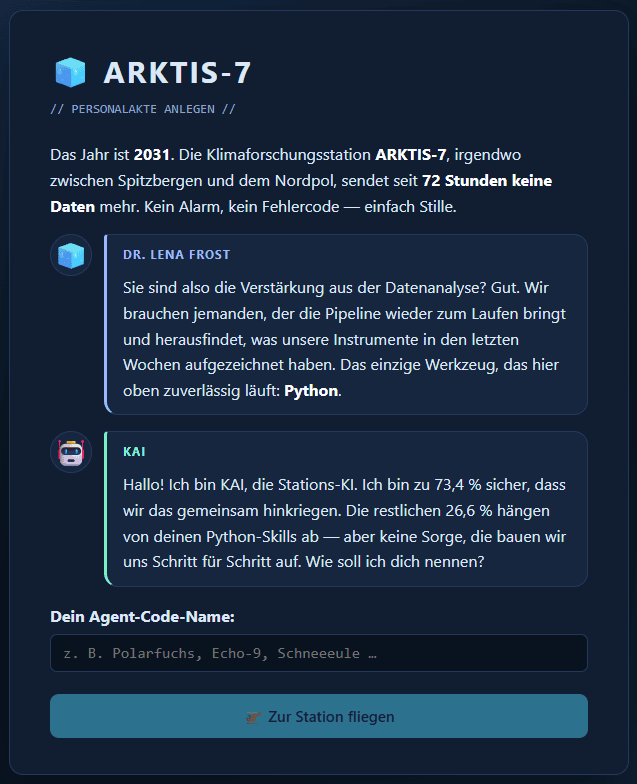
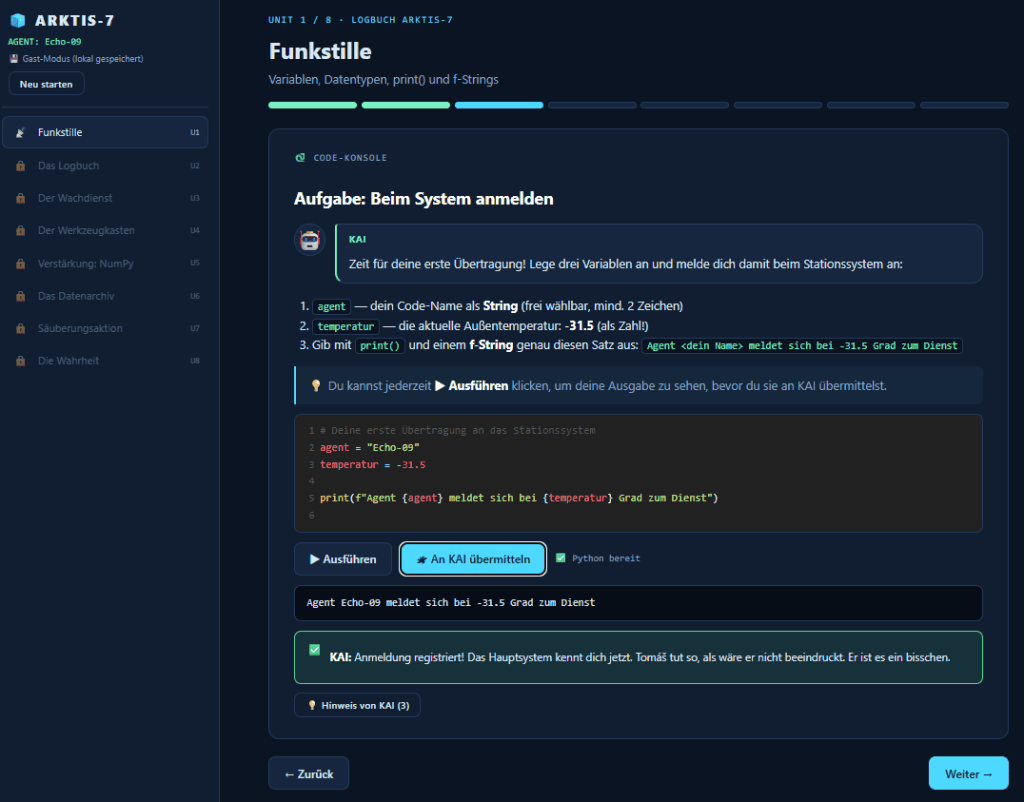
The eight units follow a fixed rhythm: story → lesson → coding tasks (with automatic checks, hints, and a model solution) → cloze text → multiple-choice quiz → final mission → story outro. Units unlock sequentially as students complete them.
| # | Unit | Content |
|---|---|---|
| 1 | Funkstille (Radio Silence) | Variables, data types, print(), f-strings |
| 2 | Das Logbuch (The Logbook) | Lists, indexing, slicing, dictionaries |
| 3 | Der Wachdienst (The Watch) | if/elif/else, for loops, conditions |
| 4 | Der Werkzeugkasten (The Toolbox) | Functions, return, parameters, defaults |
| 5 | Verstärkung: NumPy (Reinforcements) | Arrays, vectorisation, statistics, boolean masks |
| 6 | Das Datenarchiv (The Archive) | Pandas, read_csv, head/describe, filtering, sort_values |
| 7 | Säuberungsaktion (Cleanup) | Data cleaning (NaN, duplicates, error codes), matplotlib |
| 8 | Die Wahrheit (The Truth) | EDA finale: merge, difference analysis, resolution |
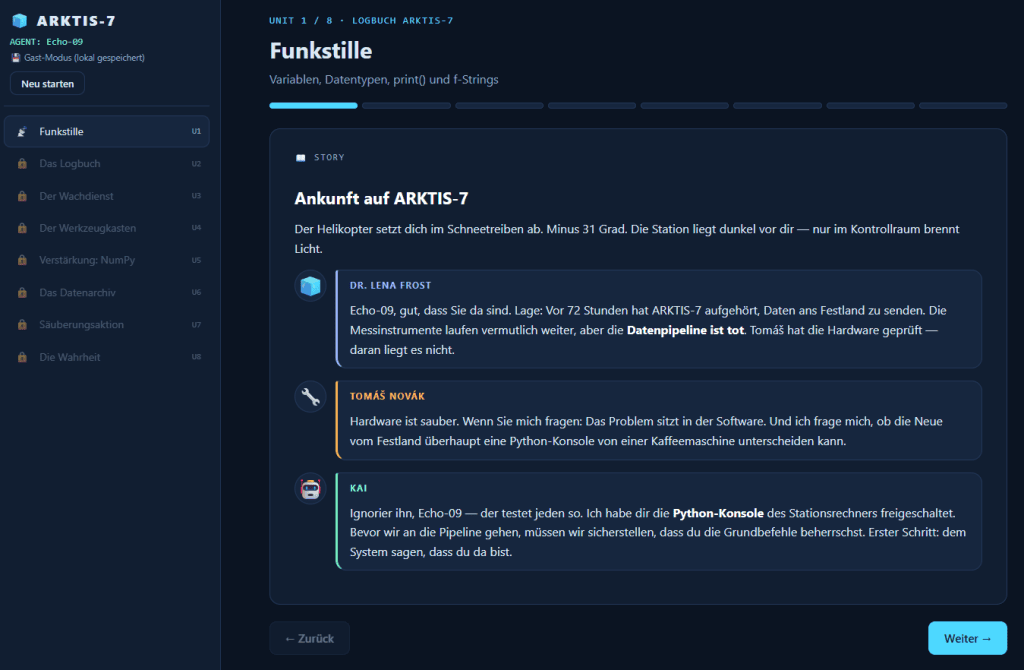
There’s a small optional layer for progress saving: Google login via Firebase, storing progress in Firestore. Without that config, the course just runs in guest mode with progress kept in localStorage. I haven’t tested the guest mode edge cases yet (what happens if you close the browser, etc.). On the list.
The Number That Made Me Sit Up
Total time for round 1: roughly 50 minutes of actual development with Fable 5 in Claude Code, plus maybe 10 minutes upfront for the prompt and thinking through the storyline.
Sixty minutes. For a working, story-driven, eight-unit interactive Python course with in-browser code execution, automated checks, cloze exercises, and quizzes. I tested through Unit 3 so far and haven’t hit a single bug or anything I wanted to change. That’s — I don’t really have a follow-up sentence for that. It’s just cool.
What’s Still Open
Two things on my list before this is actually classroom-ready:
Visualisations in Pyodide. Code execution works fine on GitHub Pages, but matplotlib output doesn’t render cleanly yet, and looking at the unit content, visualisation doesn’t seem to have been a real focus of the course as generated. That’s a problem for me specifically, because the lab this feeds into is exactly about exploratory data analysis, where plots are the point. Needs fixing before I can use this in the actual course.
Guest mode persistence. Untested. Might be fine, might lose progress on a refresh. Need to actually try it before I trust it.
Language: the course is in German, matching how the lecture itself runs, is taught in German at Pforzheim. So, apologies to any non-German-speaking readers who click through expecting to follow along.
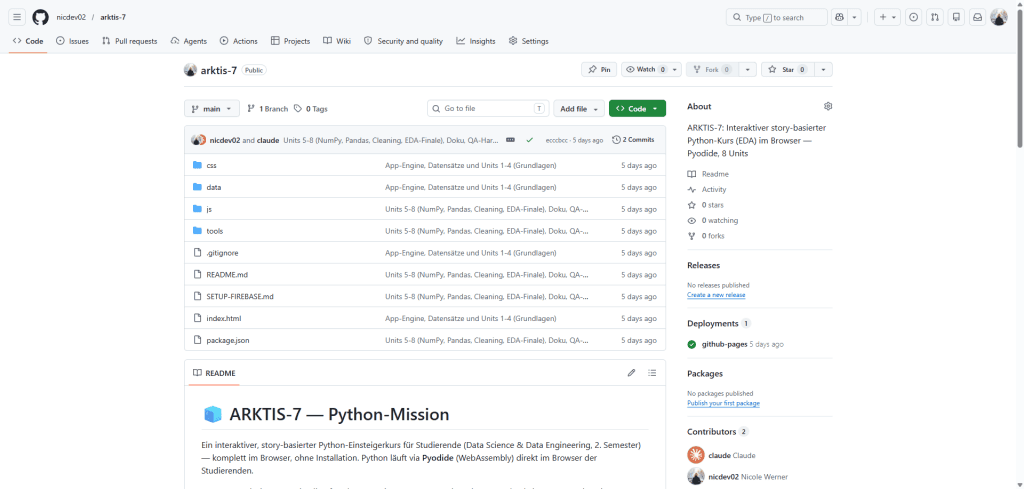
If you want to poke around yourself: the current state is on GitHub, and the live version runs on GitHub Pages. Fair warning, though, I’m actively reworking this, might still switch to a different architecture entirely, and the course could go offline again without notice. I also haven’t properly gone through and revised the content yet, so treat anything you find with a generous amount of “work in progress.” That said, if you do look, I’d genuinely love to hear what you think. 😀
Round 2: Sunday, and a Plot Twist
Today I sat down to continue, Unit 4 onwards, fix the visualisation issue, the usual. And then I saw the news: on 12 June, the US government issued an export control directive ordering Anthropic to suspend access to Fable 5 and Mythos 5 for all foreign nationals, anywhere, including outside the US. As a German user, that’s the category I fall into, but the practical effect goes further: Anthropic says the directive forces them to disable Fable 5 and Mythos 5 for all customers, US-based or not, to ensure compliance.
Worth being precise about what this actually is, because “Claude banned” headlines are doing a lot of work right now and most of them oversimplify. According to Anthropic’s statement, the US government cited national security authorities and issued an export control directive to suspend all access to Fable 5 and Mythos 5 by any foreign national. Crucially, access to all other Anthropic models is not affected, this is specifically about the Mythos-class models, not Claude as a whole.
The reasoning, per Anthropic: the government’s concern appears to relate to a method of bypassing or “jailbreaking” Fable 5, and Anthropic says they reviewed a demonstration of this technique being used to find a small number of previously known, minor vulnerabilities, vulnerabilities that other publicly available models can apparently find too, without needing any bypass. Anthropic’s position is essentially: this is a narrow, non-universal jailbreak finding, comparable to risks that already exist across the industry, and they disagree that it should be grounds for pulling a model deployed to hundreds of millions of users while also stating they’re complying with the directive.
So: not a ban on Claude, access to every other Anthropic model is unaffected. And not a case of “everyone except foreign nationals keeps access” either: per Anthropic’s own statement, nobody currently has access to Fable 5 or Mythos 5, regardless of where they’re based. The directive’s legal target is foreign nationals specifically, but the rollout is a blanket shutdown.
I genuinely don’t know how this resolves. Anthropic says they’re working to restore access and frames it as a misunderstanding; the government directive stands until it doesn’t. My guess, and it’s only a guess, is that if access comes back for people like us within the next few weeks, it’ll come back with an even shorter leash than Fable 5 already had.
The Actual Question This Raises
Stepping back from the course for a second, because this is the part I keep turning over: how far along is AI capability development, really, right now?
Here’s a model that, in its safeguarded, public-facing, deliberately dialled-down form, still triggered a national security export control within three days of release, over its ability to find vulnerabilities in code. Not the unrestricted Mythos 5 version. The one with the guardrails on. And Anthropic’s own framing of the incident is essentially “yes, but every other frontier model can do this too, this isn’t special”, which, if true, is its own kind of unsettling.
I built a Python course for second-semester students with this model in under an hour. The same model class is apparently capable enough at security analysis that governments are actively restricting cross-border access to it. Both of those things are true about the same technology, three days apart.
I don’t have a tidy conclusion here.
What’s Next
Once I have access to a Fable-class model again (whenever that is, possibly a more restricted version, possibly via API only as originally planned for 22 June), Unit 4 onwards and the visualisation fix are next. Failing that, Opus 4.8 can certainly continue the work, just maybe not quite at the same 50-minutes-for-eight-units pace.
For the course itself: once Units 4–8 are tested and the matplotlib issue is sorted, ARKTIS-7 goes live for the Data Science & Data Engineering lab, 2nd semester. I’ll report back on how it lands with actual students, which, frankly, is the test that matters more than anything above.
A note on process: the ideas, experiences, and opinions in this article are mine. Claude helped me shape them into readable English. The factual details about Fable 5, Mythos, and the export control directive were verified against Anthropic’s official statement and contemporary reporting before writing.